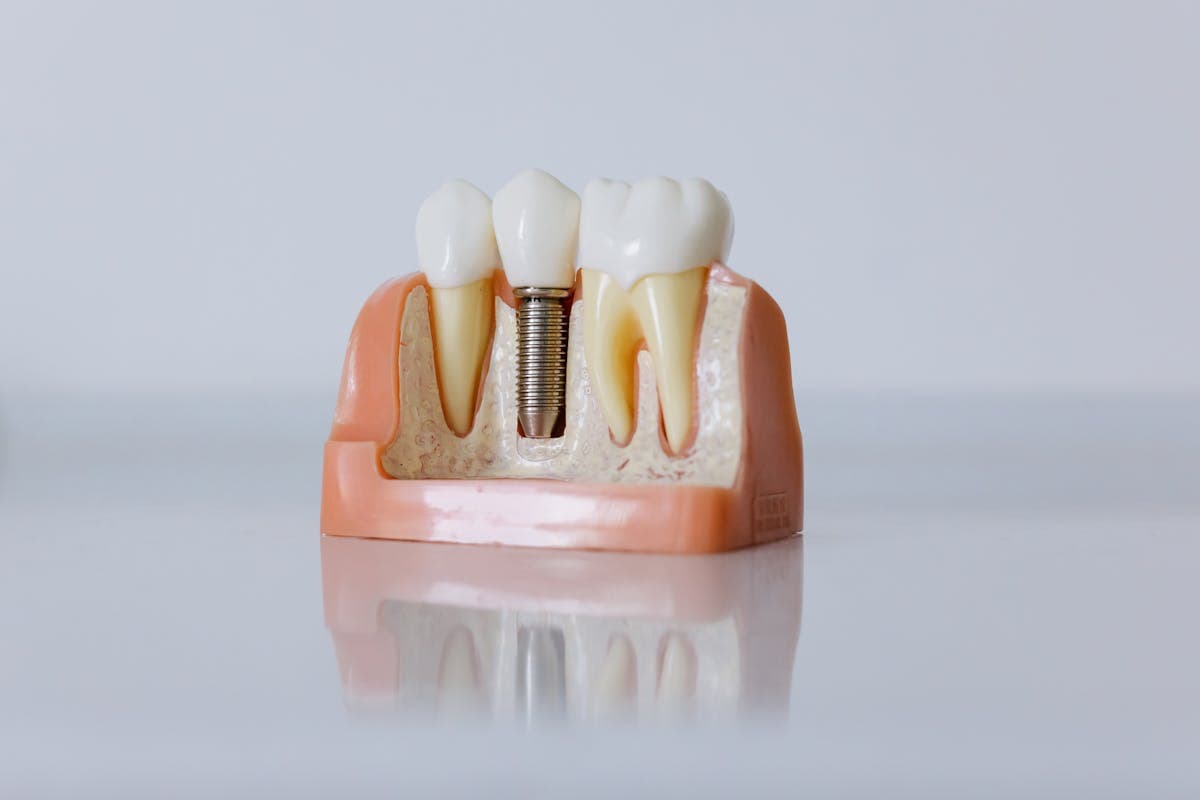
What happens during a dental implant procedure?
A dental implant replaces a missing tooth from the root up. Rather than resting on the gum or leaning on neighbouring teeth, it is anchored in the jawbone itself.
The thing most people do not realise going in is that it is not a single appointment. It is a sequence spread over several months, and most of that time is healing rather than treatment. You are not in a dental chair for months; you are getting on with life while bone does its work.
Assessment and planning
An examination and a 3D scan show the bone volume, the position of nerves and sinuses, and how the neighbouring teeth sit. This is where it is decided whether an implant is the right answer at all, and whether any preparatory work is needed first.
Preparation, if needed
If the tooth is still present it may need extracting. If bone volume is insufficient, a graft is placed and given months to mature. Many patients skip this stage entirely.
Placing the implant
Under local anaesthetic, the gum is opened, a channel is prepared in the bone, and the titanium post is placed. The gum is closed over or around it. For a single implant this usually takes about an hour.
Osseointegration — the healing phase
Bone grows onto and bonds with the surface of the post over roughly three to six months. This is what makes an implant stable in a way no other restoration is. Nothing is required of you during this except normal care and keeping check-ups.
Abutment and impressions
Once fused, a connector called an abutment is fitted to the post, and impressions or a digital scan are taken so the laboratory can make a crown matched to your other teeth.
Fitting the crown
The custom crown is fitted and the bite adjusted. This is the appointment where it stops being a treatment and starts being a tooth.
How long does a dental implant procedure take?
Two different questions hide inside this one.
The surgery — placing a single implant is typically about an hour, including anaesthetic and preparation. Many people are surprised at how ordinary the appointment feels.
The full treatment — from first consultation to finished crown, a straightforward single implant usually runs three to six months. Almost all of that is healing time. Add several months if a bone graft is needed, or if an extraction has to heal first.
Some cases allow a temporary tooth during the healing phase, so you are not left with a visible gap. Whether that is possible depends on where the implant is and how stable it is at placement — ask specifically, because it matters a lot to most people and is not always volunteered.
Is the procedure itself painful?
Briefly, because this is the question everyone asks: placement should not hurt. The area is thoroughly numbed, and you will feel pressure and vibration rather than pain. Patients who have had a difficult extraction often describe the implant placement as the easier of the two.
Afterwards, expect soreness rather than sharp pain, peaking around 48 hours. For a fuller account of what is normal healing, what is a warning sign, and when to call, see dental implant side effects — it covers the recovery in detail.
If dental anxiety is the real barrier rather than the pain itself, say so before treatment is planned. It changes the approach — see our dental anxiety guide.
The treatment timeline, stage by stage
This is the schedule of the treatment rather than a symptom guide — for whether a given symptom is normal, use the side effects guide.
| When | What is happening | | --- | --- | | First 24 hours | Some oozing is normal. Ice on and off, soft cool foods, no rinsing, no straws, no smoking. Rest. | | Days 2–3 | Peak swelling and soreness, then improvement. Most people return to work and normal activity. | | Days 4–7 | Discomfort largely gone. Gentle brushing near the site as directed. Eating more normally on the other side. | | Weeks 2–3 | Soft tissue healed. Any sutures removed or dissolved. Back to full normal routine. | | Months 1–6 | Osseointegration. Nothing to feel or do, beyond normal care and scheduled check-ups. |
How long does a dental implant last?
Implants are among the most durable things in dentistry. With good daily care and regular professional cleanings, 20 years or more is routine, and many last for life.
Worth separating the two parts, because they age differently:
- The post is titanium, fused into bone. Barring complications, it is not the part that wears out.
- The crown on top is subject to the same wear as any other crown, and may need replacing after 10 to 15 years or so.
The single biggest threat to a long-lasting implant is peri-implantitis — gum disease around the implant. An implant cannot decay, which lulls some people into relaxing their hygiene. The gum and bone supporting it are very much still vulnerable. Brushing, cleaning between teeth, and keeping regular cleanings is what protects the investment. Smoking meaningfully increases the risk of failure.
Are dental implants covered by insurance?
Coverage varies more here than almost anywhere else in dentistry.
- Some extended plans contribute toward parts of implant treatment — occasionally the crown but not the surgery, or a fixed annual amount.
- Many plans exclude implants entirely, treating them as an upgrade over a bridge or denture.
- Missing tooth clauses are common: if the tooth was lost before your policy started, treatment to replace it may be excluded regardless.
- The CDCP does not cover implants, and does not cover bone grafts at any income tier. OHIP does not cover either.
The practical step is a predetermination: your dentist submits the proposed treatment and your insurer responds with what it will actually pay, in advance. It takes a few weeks and replaces guesswork with a written answer. Our guide to what dental implants cost in Ontario covers how implant treatment is priced and what an itemized estimate should show you.
Who is a good candidate for a dental implant?
Most healthy adults are. The factors that actually matter:
- Enough bone to hold the implant, or willingness to have a graft first.
- Healthy gums. Active gum disease is treated before an implant is placed, not alongside it.
- Finished growing. Implants are generally not placed in adolescents whose jaws are still developing.
- Well-managed general health. Uncontrolled diabetes, some medications affecting bone metabolism, and recent head or neck radiotherapy all need discussion — they do not automatically rule you out, but they change the plan.
- Not smoking, ideally. Smoking is the most significant modifiable risk factor for implant failure.
Next steps
Implants have a high success rate, but no honest guide claims a perfect one. Risks, warning signs, and what causes implants to fail are covered in full in our guide to dental implant side effects — that is the page to read before treatment if complications are your main concern.
If you are weighing an implant against the alternatives, our crowns and bridges and dentures pages set out how those compare, and dental implants covers how we approach implant treatment in Richmond Hill.